Triangulum Constellation: The Triangle and the M33 Galaxy
The northern triangle points toward a neighbouring galaxy where young stars are changing the clouds around them.

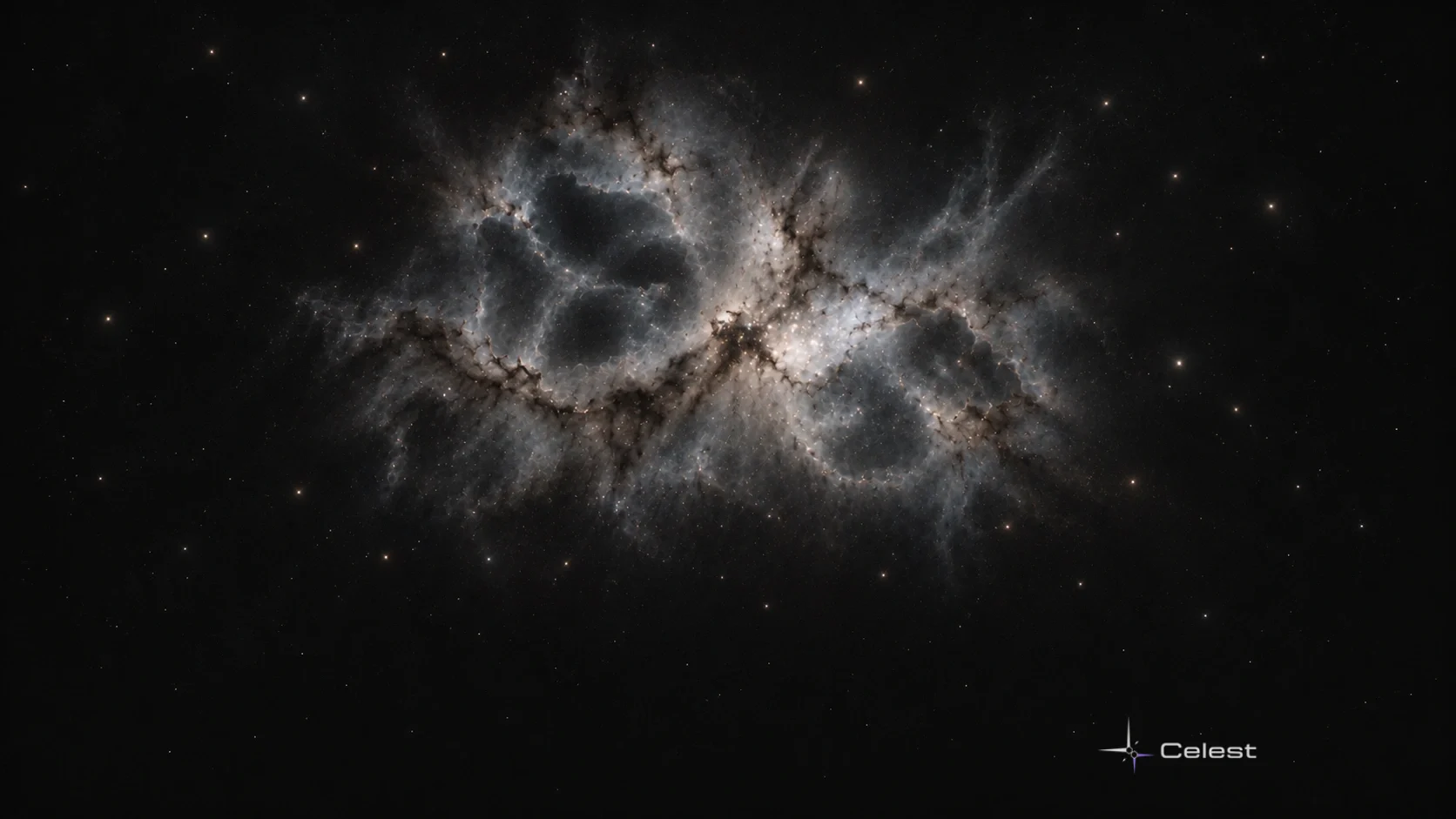
Triangulum is a northern constellation with a triangular outline and a spiral galaxy, M33, in the same direction. The stars help you recognise the region; the galaxy takes the search far beyond our Milky Way, into a system rich in places where new stars form.
Start with the constellation map and its neighbours, including Andromeda, Aries and Perseus. Matching the triangle is the first task. Searching for M33’s faint, spread-out light is a different observation, requiring attention to the sky and to how much of it your instrument shows.
Triangulum at a Glance
- Sky region: a northern constellation bordered by Andromeda, Pisces, Aries and Perseus.
- Seasonal context: winter evenings in the Northern Hemisphere; summer evenings in the Southern Hemisphere.
- Main galaxy: M33 ranks third in size in the Local Group, behind Andromeda and the Milky Way.
- Distance reference: approximately 3 million light-years for M33, rather than for the constellation’s stars.
- Observing challenge: a diffuse galaxy suited to a broad field and low magnification under dark skies.
- Stellar nursery: NGC 604, containing more than 200 very hot, massive young stars among gas and dust.
Recognise the Triangle, Then Look for M33
Use the neighbouring constellations to settle the triangle’s position. The live sky chart lets you match that arrangement for your chosen time. The seasonal guidance is a starting point, while the current chart supplies the direction and orientation that apply to your evening.
M33 is also called the Triangulum Galaxy. Its relatively face-on orientation lets professional observations follow the spiral pattern and examine how stars and gas are arranged. Its membership of the Local Group places it among our galactic neighbours, despite the enormous distance separating it from Earth.
A light-year is the distance light travels during one year. At about three million light-years, this galaxy is far beyond the stars outlining Triangulum. A constellation name identifies where to look on the sky; it does not imply that the objects found there belong to one physical gathering.
Begin with low magnification and a broad field, such as a binocular view. NASA lists the galaxy at apparent magnitude 5.7; magnitude describes apparent brightness, with larger values meaning fainter objects. The light is diffuse, so recognising the galaxy requires a different approach from locating a sharp stellar point.
November is a favourable month in the observing description. Unaided-eye sightings demand exceptionally dark, clear skies, so binoculars make a sensible first approach. Check the observing conditions before the session, and look for the galaxy itself before expecting a detailed spiral pattern.
A Mosaic Separates Millions of Stars
Professional close-ups take that diffuse view much further. A Hubble mosaic released in 2019 combines 54 fields and distinguishes roughly 25 million individual stars. That number describes the surveyed portion of M33, rather than a complete census of the galaxy or a count you could reproduce through binoculars.
The observations were collected between February 2017 and February 2018. Joined fields provide detailed views of star clusters and regions of star birth across part of the galaxy. Looking relatively straight toward the disc helps researchers compare those populations with the spiral structure around them.
Long before that mosaic, changing stars helped establish what M33 actually was. In the 1920s, Edwin Hubble investigated stars whose brightness rises and falls periodically. Those observations helped him estimate a distance that placed the object outside the Milky Way, establishing it as a separate galaxy.
A blurred appearance alone had not supplied the answer. Measurements of its stars turned a patch of light into a galaxy with an estimated distance. The modern resolved images let researchers examine many more individual objects within that already identified galactic system.
Young Stars Reshape NGC 604
NGC 604 is a large region of star formation inside M33. Gas and dust surround more than 200 very hot, massive stars still early in their lives. This is a description of a particular massive-star population, rather than the number of every kind of star in the cloud.
The 2024 Webb description estimates the region’s age at around 3.5 million years. Its images show irregular cavities and extended threads of material. The cavities are associated with powerful stellar winds: outward flows of particles from the hot young stars, pushing into the surrounding matter.
New stars therefore change their own surroundings. The cloudy environment is not simply a backdrop that remains untouched after birth; the stellar winds carve openings in its gas and dust. Shapes visible in the images record the interaction between the young stars and the material around them.
Ultraviolet radiation changes the gas as well. It ionises atoms, removing electrons, and the surrounding hydrogen emits light. Farther from the cleared regions, cooler molecular hydrogen offers material favourable to star formation. The glowing, cleared and cooler parts describe different conditions within the broader cloud.
Infrared Views Emphasise Different Material
Webb observed NGC 604 with a near-infrared camera, NIRCam, and a mid-infrared instrument, MIRI. Both measure light outside ordinary human vision, at different wavelengths. Each view gives some components more prominence than others, adding information about the relationship between the stars, gas and dust.
In the mid-infrared view, hot stars are less conspicuous because they emit less light at those wavelengths. Cooler gas and dust glow more prominently. Fewer visible stellar points in that image describe what the instrument emphasises, rather than a rapid change in the number of stars.
Near-infrared detail also connects gas structures that had looked like separate patches in visible-light images. Combining the views makes the young stars’ influence easier to investigate. The nursery is simultaneously a place where stars form and a cloud whose new stars are already changing its structure.
Leave a comment
Comments appear after moderation.